Categories
Goal Setting Goals

Aiming to Run 1,000 Kilometers, and Other Goals for 2025

My weekends already look quite different than they did in 2024.

One of my favorite things about the Christmas holiday season is the opportunity to reflect. To take stock of my life. To zoom out and re-imagine things.

Where am I succeeding?

Where am I growing?

Where do I need to realign my investments of time and energy?

An annual tradition that anchors me

An important part of this annual reflection is a goal-setting session that my dad and three brothers complete together. It usually takes us 3–4 hours to discuss each domain of life, and because we love and trust each other, we get pretty real.

This year was our twelfth annual meeting of the minds, and as always, I’m fired up for more growth in 2025.

One of the most significant changes I’ll be making in 2025 is to hit pause on weekly livestream interviews with educators. I’ve thoroughly enjoyed this hobby, but it’s taken 7–8 hours a week (mostly weekends) to get through each step of the workflow involved.

It’s actually quite painful to hit pause on these episodes, because I enjoy the activity and weekly rhythm. But freeing up this time allows me the margin to create other forms of content that I’m passionate about, including this blog post.

Why share these goals publicly?

Fair question, and I know most of my acquaintances would be horrified by the idea of sharing their own personal goals on the web.

I’m posting them here for three main reasons:

  1. When we write them down, our goals become a little more real.
  2. The power of public accountability is REAL. People may ask me how I’m doing on these goals this year, and that awareness pushes me to stick with them.
  3. Even if I don’t reach every goal, I believe that aiming for a goal is better than playing it safe and not aiming at all. Some progress is better than none.

I’m not afraid of failure.

Here they are — my goals for 2025

Physical

  1. Run 1,000 km. This will be tracked automatically on Strava.
  2. Complete daily mini-workouts (push-ups, squats, curls, stretches) for 300/365 days.
  3. Check blood pressure numbers weekly (52 times) and push my averages below 130/80. My BP numbers have always been poor, but 2024 was especially worrying.
  4. End 2025 at 189 lbs. I ended 2024 at 195 lbs.
  5. Complete the Vancouver Sun Run (10 km) in under 53:48 (my 2024 time).
  6. Complete 10+ chin-ups in one set by end of year.
  7. Bench press 135 lbs. x 20 reps (recorded PB is x 12 reps) by end of year.

Financial

  1. Invest in S&P 500 ETFs within my TFSA. Single stock-picking has been fun for the last few years, but my results haven’t kept up with the S&P. When it comes to investing, boring often wins over the long haul. It’s time to get more boring.
  2. Earn $240+ from blog posts on Medium.
  3. Earn $1,200 from AdSense on my YouTube channel for teachers. To get there, I’ll need to publish more tech tutorial content — that’s what teachers around the world find most helpful.
  4. Give successively more to charitable organizations each month than the month before. This is a trend that my wife and I have followed since marriage in 2015 and we would like it to continue indefinitely.
  5. Give spontaneously to family, friends, or those in need once a month. This often takes the form of treating another couple to a meal, but it can take other forms as well.

Marital

  1. Continue to connect with my wife on Friday Family Fun nights, Saturday date nights, and Sunday afternoons. She needs lots of quality time together and I am grateful that she doesn’t ever seem to get sick of Tim Time.
  2. Create some new travel memories together in July — location still to be determined.

Parental

  1. Connect with our younger son (he lives at home with us, but the three of us have different schedules) over a meal at least once per week.
  2. Continue to match him dollar-for-dollar on his university tuition. His mother and I share finances, so this is a shared goal.

Professional

  1. Improve my contributions to my elementary team, students, and parent community. I’m happy with my current mix of teaching and administrative duties.
  2. Support my still-to-be-hired new principal (my seventh principal in nine years) this fall.
  3. Obtain my BCCT certification. I’m currently certified to teach at all schools in Manitoba, but only independent schools in BC.
  4. Publish 50 blog posts (and matching vlog posts) about my education practice.
  5. Increase my proficiency with AI-for-teachers tools. This one is difficult to quantify, but let’s say that by year’s end I want to be leveraging AI tools in my work more than once per day.

Self-Improvement

  1. Complete daily goal tracking consistently (as in: charting my progress virtually every day) using the Strides app.
  2. Finish 12 books. I read almost every night, but I hop around a lot, so the word ‘finishing’ is important here. If you’re a reader, I’d love to connect with you on Goodreads.
  3. Publish 26+ personal interest blog posts (and matching vlog posts) like this one.
  4. Complete 24+ bedtime journal entries.
  5. Complete 24+ morning reflection and prayer journal entries. These are profoundly centering and give me great peace when I actually do them
  6. Complete 6 BC hikes and 6 paddleboard trips in the summer.
  7. Publish 12 long-form videos on each of my Vancouver reviews channel (in 2024 I published 2), travel channel (in 2024 I published 3), and my hiking and paddleboarding channel (in 2024 I published 10). The long-term goal here is to have 4–5 monetized YouTube channels by the time I retire from teaching.

Social/Relational

  1. Meet weekly with other couples from our church community to share life, learning, and friendships together. This is a life-giving practice for me and my wife.
  2. Organize and attend 10+ monthly father-son Zooms (we live in different parts of the country).
  3. Complete a first-ever camping and hiking trip with my brothers and some of their children in August. I’m dreaming of an overnight trip to Landslide Lake on Vancouver Island.
  4. Meet six times with three other male teacher friends in my area. We aim for monthly get-togethers, but about half of our meetings get knocked out by life.

Final thoughts

There you have them — most of my goals for 2025. They’re as specific, measurable, achievable, relevant, and timelined as I can make them.

What do you have in mind for this year? Whatever your goals, make sure they are quantifiable.

And if you DO make yours public, tag me below and share a link to your work. I’d love to check them out and cheer you on.

Let’s GO.

Standing near the peak of Brunswick Mountain in Lions Bay, BC

Categories
Canada Taxes

Happy Belated Tax Freedom Day, Fellow Canadians

We’re being taxed to death, but that’s not enough for some.

Did you know that the average Canadian family pays 45% of its income in taxes across all levels of government? June 13, 2024 was the day on the calendar that marked this year’s equivalent of all income earned (year to date) that will go toward taxation.

This is not a partisan comment or a hyperbolic critique — it’s simply our sad state of affairs. We pay income taxes, PST, GST, property taxes, fuel taxes, carbon taxes, and capital gains taxes, not to mention state vehicle insurance, license fees, application fees, and on and on we go.

That’s why I find it so difficult to understand my fellow Canadians who support higher taxation. Friends, we are being taxed to death. And to state the obvious, governments are not known for their efficient use of tax dollars (the federal government’s $54M ArriveCan app that didn’t work is one of many examples).

The solution is NOT to squeeze hard-working Canadians and families even more by raising taxes further. Current policies are already killing the Canadian dream — just imagine immigrating to this country in 2024 and trying to build a life today.

We don’t need more taxes. We just need better management.

Categories
Apple Investing Stock Markets Stocks Tesla

5 Stocks That Are Performing Well for Me in 2023

We’re half-way through the year, and 2022 is becoming a distant memory.

I am NOT a pro investor.

My wife and I both contribute to healthy pension plans through our employers, but if you believe Dave Ramsey, that’s not enough to assure anyone of a comfortable retirement. Do more, he encourages.

Two years ago, we agreed to start making modest monthly 3-figure contributions to our TFSAs (Roth IRAs for my American friends) through QTRade.com (which charges a $10 flat rate per trade), and we’ve kept it up faithfully ever since.

We didn’t know much about stock trading. But we were excited to learn.

Picking single stocks (as opposed to mutual funds, ETFs, indexes, or other collections) is not for the faint of heart. Prices can rise and fall precipitously based on changing economic conditions outside of anyone’s control.

And I’ll be real: the steady decline across the markets in 2022 was not fun. But instead of worrying endlessly, we simply decided to sit tight and ignore the daily news. We refused to sell, and we’ve been rewarded by the comeback of 2023 that you’ll see below.

No, you don’t need to do a ton of market analysis before buying stocks. One rule has stood me well: invest in companies that you know, like, trust, and use every day. By and large, you’ll see that theme appear often in the stocks below.

We’re half-way through the year, which means it’s a good time to give my portfolio a close review. Not every stock has been a winner, but my overall portfolio is doing well thanks to these companies.

Without further ado, here are my biggest winners of the year so far (ranked by percentage gains to date in 2023).

Five stocks that are carrying my portfolio

TSLA — Tesla

  • $211.94 USD/share: my average purchase price (prior to 2023)
  • $108.10 USD/share: market price on January 3, 2023
  • $265.28 USD/share: current market price
  • Gain/loss of the stock to date in 2023: +145.40%
  • Gain/loss on my personal investment: +25.2%
  • Dividend yield: none

Can you say WOW? Tesla’s rise this year is simply stunning.

Remember: you’ll do well to buy the brands that you know, like, and trust. My wife and I are three years into our Model 3, and this car is still a treat to drive every day. We believe in this company and its future.

When you zoom out to the five-year view on this stock, you’ll see that Tesla’s last three years have been a wild ride of ups and downs. At its peak in November 2021, Tesla hit a (split-adjusted) price of $407.36/share. From there, 2022 saw a steady decline in the share value as Tesla missed a number of expectations and Elon Musk appeared distracted by the acquisition of Twitter.

But 2023 has been all comeback. For mega-investors like Cathie Wood, who bought large shares of Tesla stock when it dipped close to $100/share in January, it’s been a good year.

Why didn’t we buy more shares ourselves? Well, it’s the uncertainty of the markets, I guess. Nothing is a sure thing.

But going back to my rule of investing in the big companies that we know, like, trust, and use every day, we won’t make that same mistake twice.

PMET — Patriot Battery Metals, Inc.

  • $4.08 CAD/share: my average purchase price
  • $5.69 CAD/share: market price on January 3, 2023
  • $13.32 CAD/share: current market price
  • Gain/loss of the stock to date in 2023: +134.09%
  • Gain/loss on my personal investment: +226.5%
  • Dividend yield: 0.50%

It’s been a fun ride with Patriot Battery Metals, a small Canadian mining company with a focus on lithium (an important mineral in the car battery industry). Sadly, when a relative advised me to get in on Patriot when the stock was under $0.30/share, I was reluctant to move. Once the stock grew from there to $4.00/share, I swallowed my chagrin at the profits missed and finally purchased. It continues to grow.

As you can see, this stock has not produced a steady climb, so my wife (who also owns shares) and I don’t watch prices here too closely. That said, we’d love to see Patriot return to its high of $17.53/share set in June of 2023.

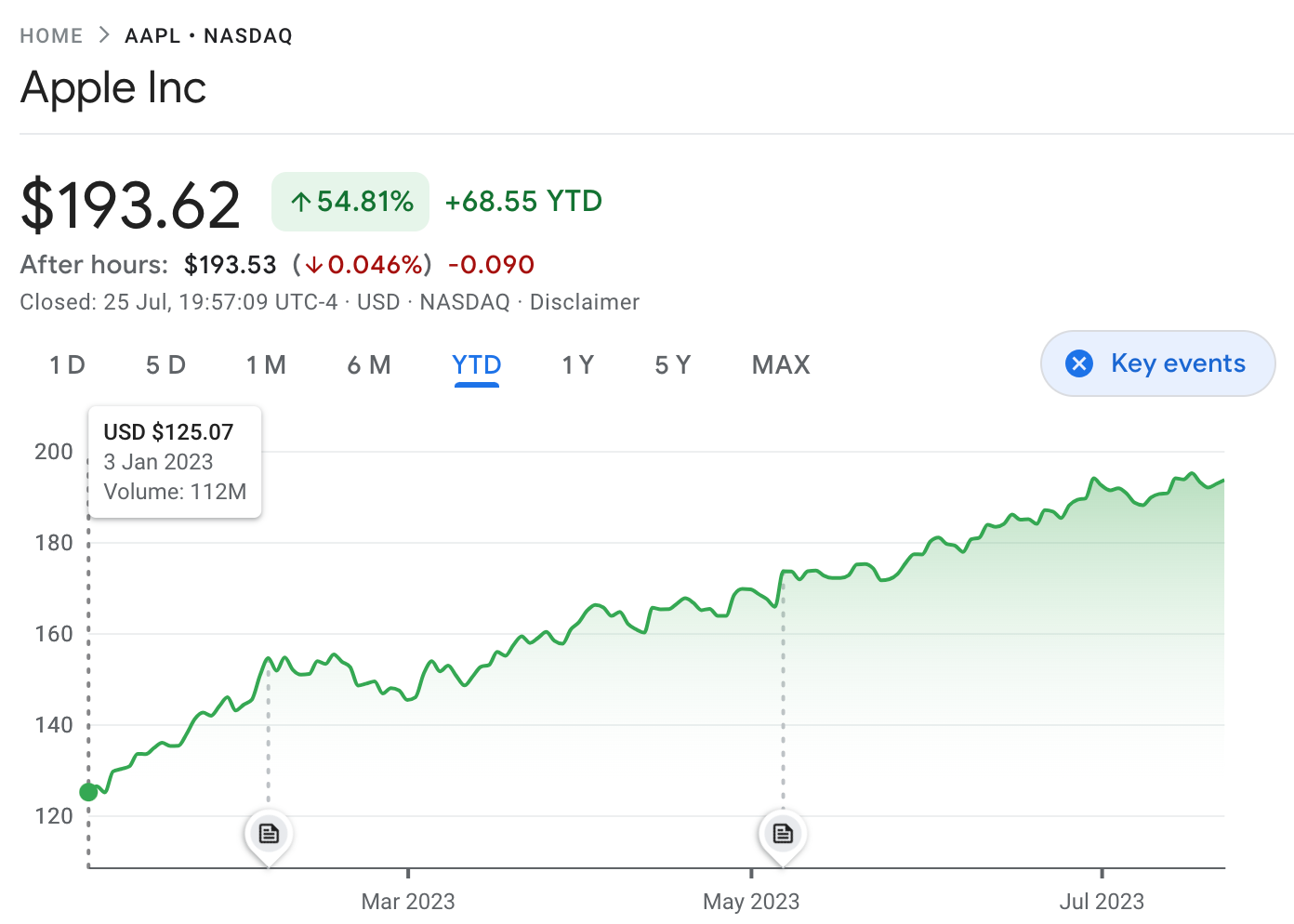
AAPL — Apple

  • $130.05 USD/share: my average purchase price (prior to 2023)
  • $125.07 USD/share: market price on January 3, 2023
  • $193.62 USD/share: current market price
  • Gain/loss of the stock to date in 2023: +54.81%
  • Gain/loss on my personal investment: +48.9%
  • Dividend yield: 0.50%

Remember when the doubters predicted that Apple would tank after Steve Jobs left the company? Fun times.

Apple is the largest company in the world by market cap and continues to lead the way in terms of quality and reliability. I’m currently writing on a Macbook Pro and sitting with an iPhone 13 Pro, an Apple Watch, and AirPods. I’m all in on Apple.

How long will Apple’s ascent continue before it hits a significant trough? For the time being, Apple investors are watching closely to see if the stock can break $200/share.

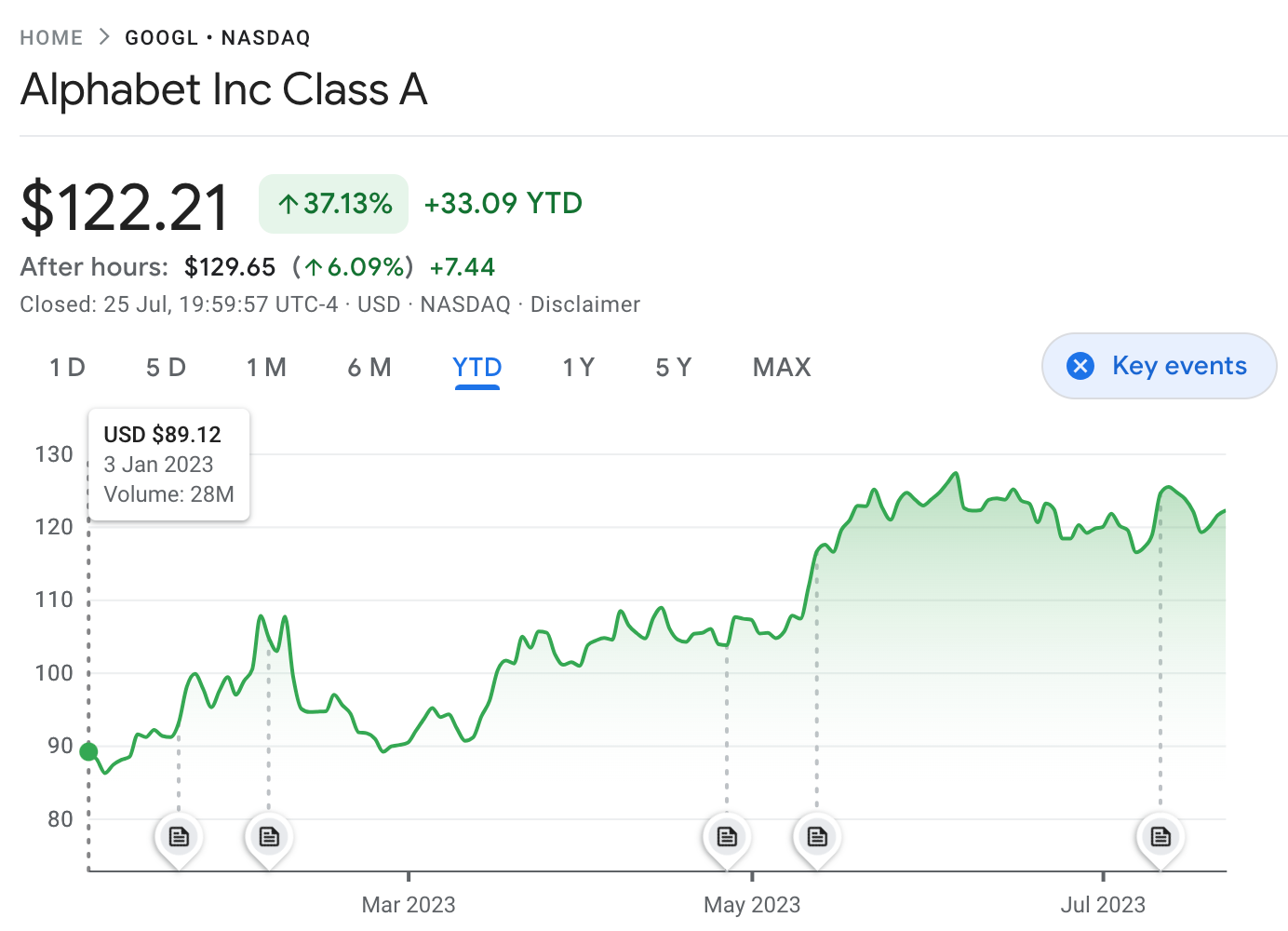
GOOGL — Alphabet (Google)

  • $108.40 USD/share: my average purchase price (prior to 2023)
  • $89.12 USD/share: market price on January 3, 2023
  • $122.21 USD/share: current market price
  • Gain/loss of the stock to date in 2023: +37.13%
  • Gain/loss on my personal investment: +12.7%
  • Dividend yield: none

Google is yet another brand that I know, love, and use every day. I am writing this blog post in Google Docs, for example. I spend time in the Google Workspace every day without fail in both my personal and professional lives.

As the fourth largest company in the world, this monster’s continued growth seems assured. With a host of services that the world relies on every day, it’s not going anywhere.

Even with a gain of 37% on the year, I consider this a safe investment for the indefinite future. That said, would I like to see something new, bold, and innovative from this company? Yes.

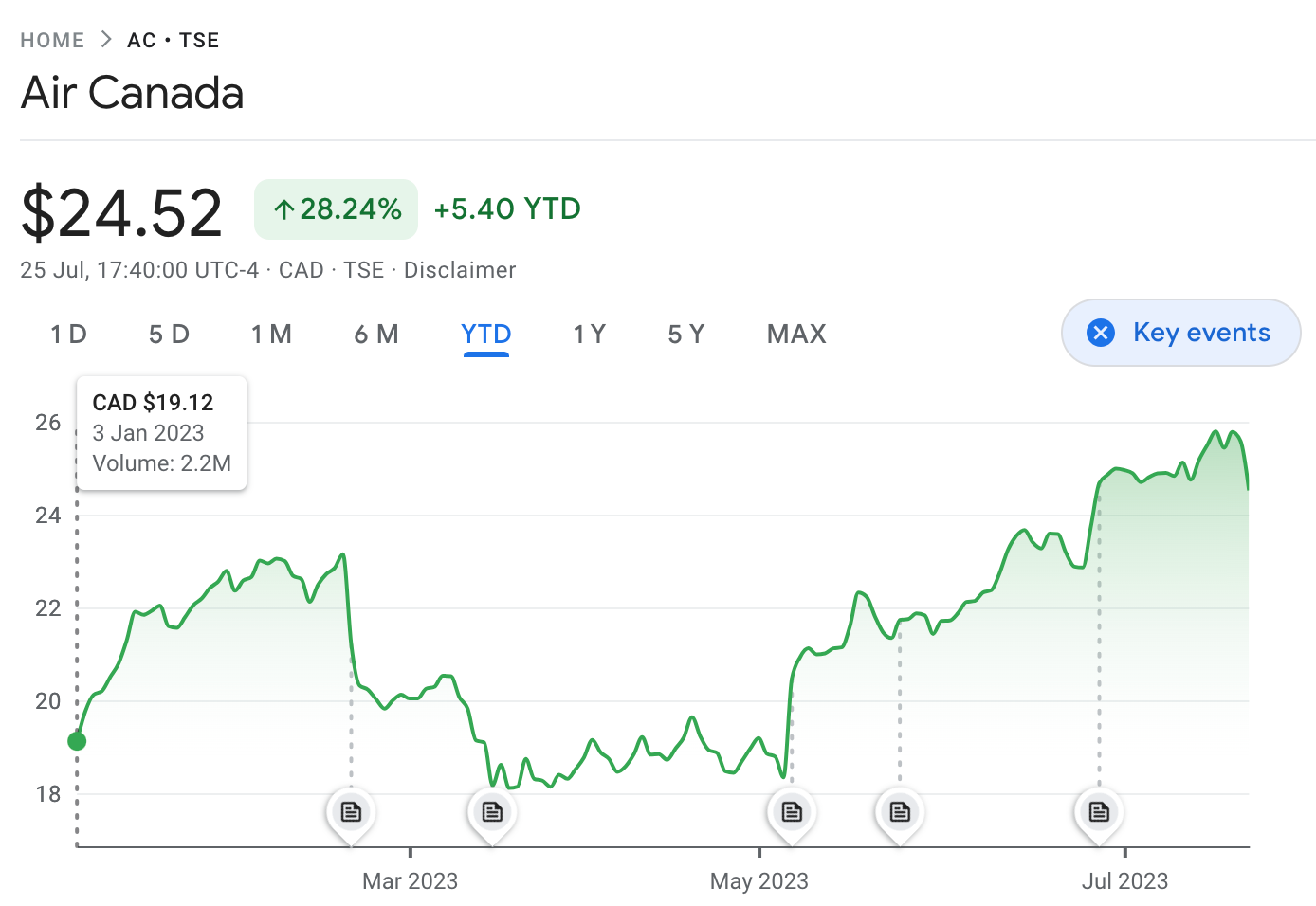
AC — Air Canada

  • $23.36 CAD/share: my average purchase price (prior to 2023)
  • $19.12 CAD/share: market price on January 3, 2023
  • $24.51 CAD/share: current market price
  • Gain/loss of the stock to date in 2023: +28.24%
  • Gain/loss on my personal investment: +4.9%
  • Dividend yield: none

I first bought Air Canada shares at the heart of COVID times, thinking a major bounce-back after the pandemic was all but inevitable once the pandemic was over (shares sat at $51.08 in January 2020, so I figured they would make their way back to those heights quickly).

That comeback has been slow, but the word from the airlines is that customers are BACK. Air Canada recently boosted its earnings forecast for 2023, and I expect this climb to continue.

What’s winning for you right now?

Western markets have been defying the doomsday recession predictions so far this year. Will this trend continue for the rest of the year? And which companies have performed well for you? Let me know.

Categories
Vancouver Cafe Reviews

Review of Cafe Etoile in Langley, BC

My wife and I visited Cafe Etoile for the first time on Saturday, March 25, 2023 and LOVED it. In addition to the video, here are a few notes.

Vibe and Atmosphere: relaxed, lofty (high ceilings, exposed concrete floors, solid furniture)

Cleanliness of Space: not much to complain about

Wifi and Power Situation: passworded network, excellent speed, stable signal, plenty of power outlets

Power Outlets Easily Available: yes

Beverage Quality: Americano and oat milk latte were both good

Food Quality: freshly made, well-presented, and delicious

Washroom Situation: bright, modern, clean, well-maintained

Categories
Entrepreneurship Gig Economy Growth Mindset Legacy Self-Actualization

The Courage to Show Up

“The courage to be vulnerable is not about winning or losing, it’s about the courage to show up when you can’t predict or control the outcome.” — Brene Brown in Dare to Lead

Image for post
Photo by Andreas Fidler on Unsplash

Human beings are creatures of control.

We crave certainty. Where certainty doesn’t exist, we’ll accept probability. As a rule, we like to know the outcome before we start.

It’s why people tend to stay in jobs that make them unhappy for years and even decades. They make a calculated trade of happiness and self-actualization in exchange for certainty.

Golden handcuffs.

Just tell me my job is secure and my wages are guaranteed, the thinking goes. Give me good benefits, a strong pension at 65, and I’ll serve you for life.

That’s how highly we value certainty and stability.

The safe life.

Sure, we all entertain dreams from time to time. Dreams of doing the extraordinary. Of making a bigger impact. Of making greater contributions in the lives of others. Of attempting the bold and ostentatious, whatever that looks like in our world.

We dream of showing up in a big way. But as long as it remains a dream, the outcome is certain — zero chance.

If All We Had to Do Was Dream

I mean, the dreaming part is fun. Put a guaranteed road map in front of me, and my willingness to show up for the extraordinary shoots way, way up.

  • Tell me that if I launch a small business, it’ll be instantly successful and cash flow positively within its first year.
  • Tell me that if I buy an investment property, I’ll be able to find fantastic tenants and the property will appreciate steadily over time.
  • Tell me that if I launch an NGO, it’ll seize the imagination of thousands and make life-changing impact in a developing country.
  • Tell me that if I become a realtor I’ll be able to sell multiple listings per month from the outset.
  • Tell me that if I start working on a Youtube channel today, I’ll have 1M subscribers in five years.
  • Tell me that if I study for the LSAT, I’ll pass the exam and be accepted into law school.
  • Tell me that if I do the research and work to write a book, it’ll become a bestseller.

Of course, none of us have those sorts of guarantees. Sure, there are principles of hard work and investment that we can rely on to a certain extent. But no guarantees.

And so we tend to be a little cagey about showing up for risky ventures. About sacrificing to make big changes. About actually showing up when outcomes are uncertain.

So we hedge our bets.

The Many Fears of Failure

The fear of failure looms large. Unpack the fear of failure, and we find other fears.

  • Fears of rejection.
  • Fears of appearing foolish or naive in the eyes of others.
  • Fears of forever losing the time, energy, and capital required.
  • Fears of social judgment — “Who do you think you are, anyway?”
  • Fears of what we would have to say to ourselves if we were forced to admit defeat.

YouTube: A Case Study

I remember when our 14-year-old was 12. For a while, he was intensely interested in editing videos. He was dramatic, creative, and enjoyed performing.

He launched a YouTube channel at the time and dabbled for a while. But I saw his concern about going all in — say, committing to weekly publishing.

The fear of low views and poor response was real. What would it say about him if he went to all this work and there was little to no positive response? Could that result be even worse than never trying anything at all?

Those questions don’t go away in adulthood. They only get louder.

Fear is Something to be Dealt With

One quote that made a big impression on me last year was this one from Elizabeth Gilbert, who writes about risk-taking in her book, Creative Living Beyond Fear:

“Fear is always triggered by creativity, because creativity asks you to enter into realms of uncertain outcome.

This is nothing to be ashamed of. It is, however, something to be dealt with.”

In 2019 I applied for a job that I really had no business getting. I lacked the appropriate experience, and the responsibilities would have been somewhat over my head, at least at the outset. But I knew the interview would be a good step, a good stretch for me. And sitting around the table with five people, thinking on my feet, analyzing my own strengths, weaknesses, ambitions, and vision was a valuable process.

I showed up. And I’m proud of that, because that’s the person that I want to be.

But I’m not finished. There’s still a ton of sacred safety in my life — spaces where I have yet to step out, take more risks, and embrace more uncertainty.

I have more showing up to do.

What it Looks Like to Show Up When Outcomes Are Uncertain

When I think about what showing up in uncertainty can look like, I think of some great people:

  • my brother Peter and his wife Shannon, now in the process of acquiring their fourth business by the age of 35,
  • my cousin-in-law, PJ, whose online startup continues to win big contracts,
  • my friend Karalee, who recently moved away from a secure job to launch a new business in a completely different field,
  • Trevor, a teacher, who designed and patented a new sport and recently wrote a novel on the side,
  • Chris, who is starting a new career in real estate at the age of 40, and
  • Jen Rao, who left a well-paying job and sold her home to live a life of mobility and remote work.

I could share more examples. But to me, this is what it can look like to step out and show up in big ways, even when outcomes are completely uncertain.

I salute this group.

What Might Have Been

It’s been said that the most common regrets of the dying are not the things they did but the things they didn’t do. The things they didn’t have the courage to try.

What might have been.

Let us not be those people. Let us not live our lives wondering what might have happened. Let’s go for it, even when the outcome is uncertain.

It doesn’t require quitting your job. But it does require facing your fears.

It requires showing up — even without a guarantee of success.

“It is not the critic who counts; not the man who points out how the strong man stumbles, or where the doer of deeds could have done them better. The credit belongs to the man who is actually in the arena, whose face is marred by dust and sweat and blood; who strives valiantly; who errs, who comes short again and again … who at the best knows in the end the triumph of high achievement, and who at the worst, if he fails, at least fails while daring greatly.

– Theodore Roosevelt

Categories
Family Legacy Social Media

Why You Should Preserve Your Family History

We’re undervaluing the legacy possibilities of digital media.

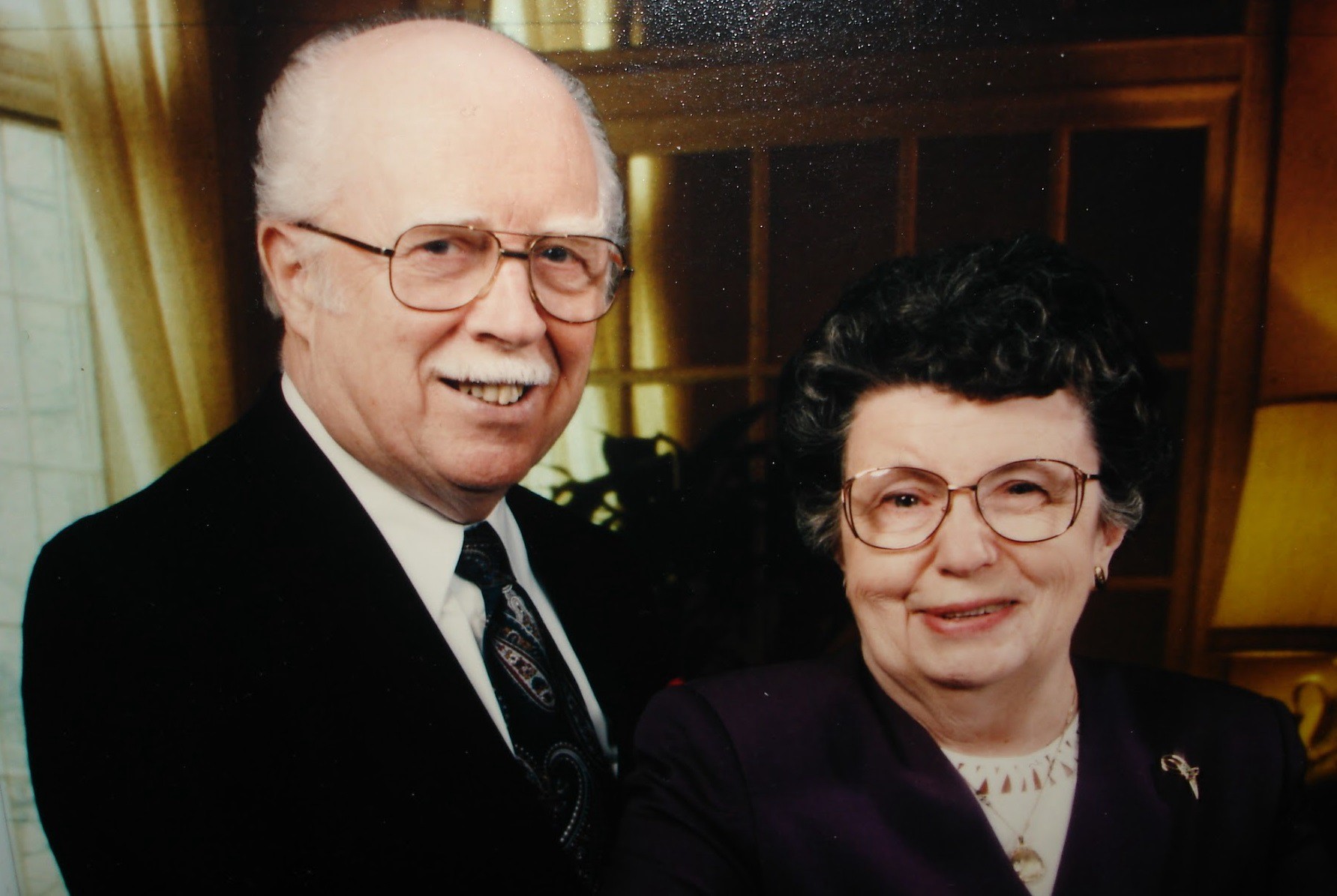
Bert and Eileen Cavey, my paternal grandparents

I miss my grandparents — all four of them.

On my dad’s side were Bert (1998) and Eileen (2009) Cavey, and on my mom’s, Jim (2003) and June (1991) McAlpine. I loved these four to the extent that a kid can love his grandparents when separated by 2,100 kilometres.

All four have been gone for a while now, but I’m old enough to remember warm memories and exchanges with each of them. I treasure those random slices of personal history, even as they blur and fade with each passing year.

I wish so much that they were still around. What would it be like to sit down and discuss life with each of them today? I’d love for them to meet my wife and my stepsons, to see my home, to visit the place where I teach.

There’d be a shift from amazement to horror, no doubt, when I tell them the market value — and then the principal owing — on my Vancouver-area home. No doubt they would each have some sage advice for my family life, my career, and the career choices of my wife and stepsons.

They’d be mystified by the hours we spend interacting with screens today, I’m sure. But both my grandfathers would also be secretly impressed, I’d like to think, by the frank level of dialogue that holds forth at our device-free family dinners.

They’d likely be surprised to learn that we’ve dispensed with the once-wonder of cable TV, but relieved to see news now available from a multitude of sources day and night on YouTube.

They’d probably be bothered by the improprieties of our non-denominational church, but hopefully they’d also be pleased by the warmth of community and quality of relationships that we experience there as well.

Silent Memories

Thinking about my grandparents makes me wish that I could consume their content. I wish I could bring up their channel on YouTube and peruse their videos for the hundredth time. I wish I could scroll their Instagram feeds — stretching back to WWII. I wish I could explore their blog posts, and read their articles, and listen to their podcasts.

I mean, just to have the opportunity, the chance, the choice … to go for a drive today and play an audio selection from my Grandpa. From the cloud to my phone — quick and easy. That’d be pretty awesome.

Of course I can’t do that today, and neither can you. Because this internet thing is still, remarkably, only 25 years old.

Building Legacy is Easy

Photo by Tanner Van Dera on Unsplash

Today’s incredible ease of access to the internet gives us new options. Unlike our grandparents’ generation, we possess all the platforms and tools to let our voice be virtually heard for years and generations to come. We are free to create, design, photograph, perform, speak, and record video in ways that can be enjoyed and interpreted in perpetuity, rendered in digital qualities that withstand the degrading ravages of time.

We have the choice, the means, the power to craft and preserve meaningful digital legacies.

Many of us will say that we don’t want to. We might feel reluctant to step up to the stage, to grab the mic, to pick up the pen, to type some thoughts and hit publish.

We feel as though we have nothing to say, that we have nothing of importance or value to add to this world.

But I say that we do — we all have something to say, to create, to express. Because it’s not really about the striking quality of your ideas, so much as it is about their origin.

It’s about YOU.

Think of your grandparents. Did they feel a similar shyness about expressing their voice? They may have, and yet how amazing would it be today to explore their videos, to relive their joys and passions, to get a sense of their goals and dreams, to understand their heart and concern for others in the world around them.

It would be amazing to understand them better, and in that journey, to understand ourselves better, too.

That. THAT is the gift that the internet offers us and our descendants today. Let’s not let it pass us by.

Categories
Communication Family Food Marriage Nutrition

High Steaks: One Family’s Quest to Navigate Nutrition

She’s paleo, and I’m not. But with caring communication and clear expectations of each other, we have a plan that will work for our family.

Just a Quick Run to the Grocery Store

It was a Saturday morning.

I noticed we were short on breakfast food supplies, so I headed off to our local grocery store with my younger stepson in tow.

While there, I stocked up on my breakfast staples: eggs, milk, bacon, eggs. I also grabbed a few quick and easy snacks that I know the boys like: a box of Kraft Dinner, a couple packs of cheap instant noodles, a block of marble cheese, three boxes of cereal, and a discounted birthday cake.

Not a big deal.

Frosty Reception

But it WAS a big deal.

We returned home with our booty, and Kristine wasn’t in the mood to celebrate. You know my beliefs around nutrition, she protested. Why are you choosing to poison our family?

Poison. Surely you’re hyperbolizing. Right?

Nope. My wife has some strong beliefs around food, and she felt that I was ignoring them.

It was time for a summit.

Separating Positions and Interests

It’s been 20 years since I took Introduction to Conflict Resolution in my undergrad, but I still remember the importance of the distinction between positions and interests.

In this case, our positions were obvious. I like to buy basically whatever food works — with three notable exceptions: pop, fries, and chips. My wife adheres to much stricter food doctrines.

Moments of tension between our positions was inevitable. But what were our underlying interests?

Before I go there, let me clarify Kristine’s position a little better.

What is the Paleo Diet?

Photo by Jakub Kapusnak on Unsplash

Kristine’s food conscience has been gradually sharpening for years, but her convictions found new heights in June of 2016. At the time, key catalysts included Netflix documentaries that you’ve likely seen or heard of: What the Health, What’s with Wheat, and Hungry for Change, among others.

These films, along with some serious research and reading, led her to the conclusion that the Paleo Diet was the only path forward. What is Paleo, you ask?

Paleo is short for paleolithic, a reference to ancestral hunters and gatherers. The idea is that if you can’t hunt or gather it in a natural setting — don’t eat it. Even wheat that is grown as a strict monoculture doesn’t make the cut.

In practical terms, the Paleo Diet means no grains, dairy, or processed foods — especially foods containing high sugar, trans fats, sulfates, and nitrates. Meat is a go, as long as it hasn’t been processed. Think steaks and chicken, but no deli meats. Paleo Leap is a helpful resource.

Much to my chagrin, the Paleo Diet rules out a ton of my personal favorites, including milk, bagels, bread, pasta, cereal, minute rice, pizza, hot dogs, burgers, and seasoned chicken wings. Although there is much I admire about the Paleo Diet, I just can’t go all in.

We Actually Share Interests

Although our positions seemed to be pure opposites, our interests are actually not too far apart.

I actually do care about nutrition. I want all of us to be fit, healthy, and cancer-free. I don’t want our boys eating instant noodles every day. But I also put high value on convenience and taste.

Kristine cares about taste and convenience as well. Like me, she works full time and doesn’t have unlimited hours to spend in the kitchen each day. But she places higher value on nutritional principles, and by extension, the consequences of ignoring those principles.

We have other common ground, as well. Kristine is willing to occasionally make Paleo exceptions for a few special items, like her favorite ice cream. There are chinks in that armor that give me hope.

Negotiating a Food Agreement

As I’ve written here previously, I believe most marital friction happens because of miscommunication around expectations. Couples don’t always have to agree, but they do need to understand common rules of the game and have clarity around expectations of the other.

With that in mind, Kristine and I sat down to have a loving and thoughtful discussion about our family’s food.

We knew we wouldn’t see eye to eye on every point. But as long as we could build some common understandings, we knew we could live happily in the tension.

Our Family Food Agreement

And we did it. We crafted a family food agreement that we can both live by. It’s on a shared Google Doc, of course, and it starts with a nutrition mission statement:

As a family, we will eat foods that nourish our bodies, provide the foundation for a healthy lifestyle, prevent illness and disease, and allow for occasional moments of convenience, celebration, and pleasure.

That last part was from me.

Our agreement goes on to break our food into three classes:

  • Class 1: Green Light. Appropriately green, these are wonderful go-to snack foods that have Mom’s full approval, foods that we’ll continue to keep stocked as often as possible. Any time we’re hungry, these are the recommended snack selections.

Finding Harmony in the Tension

Food is emotional. Some couples may be blessed to find themselves on precisely the same page in this area. We’re not one of them.

But it’s okay, because great marriages don’t thrive on unanimity — they thrive on love, care, trust, respect, and communication. And as with everything else in life, that’s our goal with food.

The boys and I will continue to eat cereal on occasion, and Kristine will still eat incomprehensible amounts of kale and avocado. But we will continue to love each other and share great food in the middle spaces.

Because families that eat together stay together. And that’s the most important interest of all.

We don’t agree completely on food, and we probably never will. But with caring communication and clear expectations of each other, we have a plan that will work for our family.

Categories
Communication Connect Time Family Relationships

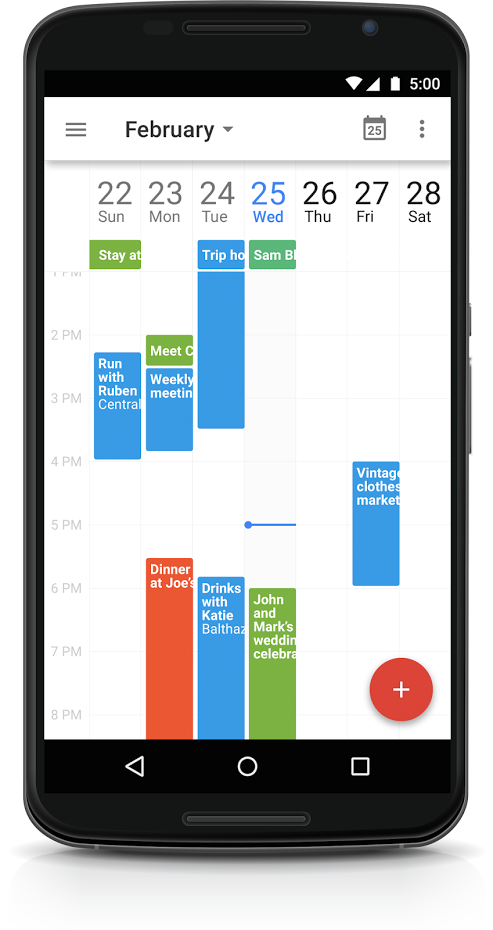
How to Use Your Calendar to Build Relationships

If it’s a relationship that matters, make the time for it.

Image Source: Android Authority

“We really need to have a conversation about this.”

“I really wish I was spending more time with my family.”

“Hey, it was great to run into you! Let’s meet for coffee some time soon.”

They’re all touching expressions of interest, and they’re often heartfelt. But they simply don’t materialize.

Days pass into weeks, and weeks pass into months. Old patterns resume. And like a receding fog, hopes and wishes slip away into the oblivion of time.

You know what they say — the road to hell is paved with good intentions. And when it comes to relationships that matter, wishes are usually not enough.

The good news? Your calendar just may be the solution.

5 Calendar Tips and Strategies to Consider

Okay, so up to this point you’ve largely ignored the calendars in your phone. You’ve added a few birthdays, and maybe your cousin’s wedding.

But you’ve never really used your calendar to actually do life.

Here’s where I would start.

1. Share your calendar with your partner.

“Google Calendar saved our marriage,” my friend Julia once told me. And I completely get it.

It’s never fun to be surprised by your partner’s activities or obligations during the week, which is why Kristine and I share Google calendars. We also make it a point to sit down together every weekend to talk through the week ahead.

I’ve even taken the additional step of turning on email notifications on for my wife’s calendar, which produces an email notification every time she adds or changes an event. Some might curse the number of emails that generates, but that’s how much I value the life synchronization.

You’re planning on meeting your girlfriends on Sunday? Got it. I’ll need to pick up the boys on Wednesday night? No problem. We’ve got a family celebration across town all Saturday afternoon? Cool.

Just don’t tell me these things at the last minute. That’s all I ask.

I believe most of marital harmony is really just communication about expectations. Seriously.

So eliminate surprises. Communicate often, share your calendars, and get in sync.

2. Actually respect your scheduled events.

When I was first warming up to my Google Calendar, I’d pencil in my good intentions — only to ignore them or push them quickly aside if something better came along.

Don’t do that. Instead, be intentional. If it’s an important ritual or practice, pencil it in and try hard to respect it.

If it’s not important, or you find yourself ignoring an event repeatedly, have that real conversation with yourself about whether the relationship is actually something that you want to invest in.

3. Share the event with the people involved.

There are a ton of reasons to do this. For one, it serves as information central regarding time and location, avoiding the plethora of “Hey, what time are we meeting?” texts.

Everyone can check the event, and because it’s a living document, everyone sees the same info in real time.

Not only that, Google Calendar gives you the option of sending an additional notification every time an event is modified. New restaurant location? Send the notice with a click.

Another reason to share the event with the people involved is that everyone can see everyone else’s attendance status. Wondering who’s coming? The event makes it pretty clear.

4. RSVP.

On that last note … actually RSVP.

When sharing an event with others, I try to keep my own attendance intentions as clear and current as possible.

Let’s say that my friend declines our weekly run — regularly scheduled for this evening. When he goes to the effort of declining the (shared) event on his calendar, I don’t have to wonder about his status or try to find his last text message. It’s right there on the event. He’s not going.

5. Email directly from the event.

Another reason to share the event with the people involved is the ability to email people directly from the event. Thinking about making a change to an event three months away?

An email sent directly from the event gives all parties quick and direct access to the event info. No back and forth required.

Weekly Commitments: for the People Who Matter Most

For the relationships and rituals that matter most, make sure they’re happening at least once a week. I find that weekly meetings and routines offer a rhythm steady enough to keep these relationships vibrant and strong.

It’s easy to set these events in motion. Just pencil the slot into your Google Calendar and set it to repeat weekly. Be thoughtful about the time window and avoid designating it as an all-day event if possible. Add notes, comments, location, and relevant links or Docs.

One example of a weekly commitment I’ve made is reading to my two stepsons at bedtime. I read for about twenty minutes with each boy on Tuesday evenings.

My friend Steve reads to his girls virtually every night. That’s amazing, but I’m not out to match him. I have to do what works for our family and my schedule. And weekly works.

Weekly bedtime readings give us a frequency that is memorable, meaningful, and allows us to follow the plot from week to week. It’s something we all look forward to.

Here are other weekly commitments on my calendar that strengthen important relationships:

  • Monday evenings: family board game night (about 30 minutes after dinner)
  • Tuesday evenings: bedtime readings with the boys
  • Wednesday mornings: weekly run on treadmill
  • Thursday evenings: small group meetings
  • Friday evenings: Friday Family Fun Nights
  • Saturday mornings: family walk to Starbucks
  • Saturday evenings: Date Night
  • Sunday mornings: church with the family

Because these are all penciled in permanently, deviations are rare and we can be pretty intentional about making them happen. When we’re asked if we’re available during these times, that’s usually a short conversation. NO.

I won’t pretend to follow these routines perfectly, because I don’t. But having them on shared calendars is a pretty big step towards consistency.

Monthly Commitments: Checking In

There are other relationships that are important, but it’s simply not practical to maintain them every single week. For some of those, I set auto-repeating monthly meetings.

Some examples of monthly meetings that auto-repeat in my Google Calendar:

  • phone call with an out-of-town brother
  • evening meeting with three teacher friends
  • Pop & Boys Night — an agenda-driven heart-to-heart update-on-life conversation with my stepsons, including “How can I be a better parent?”
  • conference call with my Dad and three brothers
  • Saturday morning breakfast with an uncle and cousin in another city

By setting these events to auto-repeat for the same day of each month, I keep these relationships on the radar and add some intentionality that could otherwise be lost to the distractions of life.

Your Calendar Can Strengthen Your Relationships

Sometimes it’s a relationship you’d like to cultivate. Other times, it’s a critical decision kind of conversation that you need to have with your partner (before the mental fog of sleep).

Whatever it is, your calendar can help. Make the decision to leverage the tool well, and you’ll experience the benefits of a structured, intentional life.

Because if it’s a relationship that matters, it won’t grow by itself.

You have to make the time for it.

three man sitting on gray surface
Photo Credit: Toa Heftiba on Unsplash

Categories
Family Finances Legacy Real Estate

When it Comes to Real Estate, Baby Boomers Can Be Game-Changers

Formidable real estate markets position parents to help their children at little to no cost.

EnterPhoto by Breno Assis on Unsplash

My Story

My parents have always been careful stewards of resources, and it allowed them to do something incredibly important in my life.

In 2006, they gave me a financial gift — one in the low five-figure range — as a down payment on a house. I was 27 at the time.

The house was not great. It was over 100 years old and situated in a run-down neighborhood. Regular drug transactions took place in the back alley.

But it was a house. And my name was on the title.

In 2015, after a move to the west coast, a refinanced mortgage, a failed marriage, nine years of semi-successful long-distance landlording, and a recent wedding, I finally sold the home.

Once the dust had settled and I paid all related expenses, the sale netted me and my bride about $40,000. Not a huge profit, by any stretch.

But using this little chunk of change and an unsecured line of credit, we were able to squeeze our way into a detached home in suburbia.

At the outset, our equity position was awful — we actually owed more to lenders than the entire purchase price of the home. I break down those figures further in House Poor and Loving Life.

But the point is that we were in a home. We knew that with two steady incomes, we could begin the process of chipping away at our enormous mortgage while market appreciation did its work.

What this meant for us was that instead of spending the $2,000+/month that families our size spend to rent, my parents’ financial assistance was allowing us to actually build equity by paying down a mortgage instead. And in that sense, it put us on a completely different financial trajectory.

My Parents Made the Difference

What strikes me about my story is that my wife and I aren’t special. Both of us earn modest five-figure incomes, which puts us in the same company as most couples our age.

What separates our story from that of many couples is that 2006 gift from my parents. Again, we aren’t talking Donald Trump money here — we’re talking low five figures. But that act of assistance was an absolute game-changer in my life.

I’ll be grateful for it for as long as I live.

The Down Payment Savings Struggle is Real

Today, the reality for most middle-class millennials is that putting aside enough money for even a 5–10% down payment (plus associated purchasing costs) in today’s market is a daunting challenge. Even at a steady rate of $1,000/month or $12,000/year in savings, these couples are looking at consecutive years of disciplined saving in order to put even a small down payment together.

And let’s face it — with high rental prices, student loans, car payments, rising gas and grocery costs, the costs of raising children, etc. — most millennials and gen-x couples aren’t banking $1,000 month over month. Even with no-fluff, scorched earth budgets, those savings aren’t easy. To make matters worse, market prices are unpredictable and prone to sudden increases.

Some Parents May Not Realize Their Ability to Help

One person’s housing crisis is another person’s equity windfall. In markets that have experienced rapid appreciation, long-time homeowners enjoy the benefits.

Of course the tricky thing about market appreciation is that it doesn’t affect cash flow whatsoever. A $1M gain in property value doesn’t translate into any more money for groceries.

And it’s for that reason that I think many parents — and to be clear, I’m not thinking of my own parents or my in-laws here — simply don’t realize the incredible power to help that they hold.

They don’t feel rich. And in a practical, everyday kind of sense, they may not be.

But thanks to the equity in their properties, they have tremendous power to be game-changers.

The Power of a HELOC

HELOCs, or home equity lines of credit, mean that baby boomers can borrow large sums at low interest by using their own home as security.

Let’s take a fictional Bob, his wife Shirley, and their daughter Jenny as examples.

Bob and Shirley purchased a home in 1990 for $300,000. In the years since, they raised a daughter that they love very much. As little Jenny grew from toddler into young professional, Bob and Shirley used their modest incomes to pay their mortgage faithfully. Today, their mortgage principal is at $50,000.

Their home has appreciated well over the last decade. Though the numbers don’t make any sense to Bob and Shirley, the local tax assessment assigns their home a market value of $1.1M.

Bob and Shirley are sitting on over $1M in equity, but they definitely don’t feel very rich. As prices rise, they continue to spend frugally throughout the year in order to maintain a modest lifestyle and remain on a track of responsible savings and investment for retirement. These are wise and responsible goals.

What Bob and Shirley fail to see is the power of a home equity line of credit. They miss the fact that a bank would gladly lend them $30,000 at 4%, or just $1,200 in interest per year.

For just $100/month, they could give or lend $30,000 to their daughter, Jenny. And that $30k would be enough for Jenny to purchase a condo.

Not a grand place. But a toe in the market. A place to call her own.

Heck, Jenny could even pay the interest on her parents’ HELOC herself, meaning the loan wouldn’t cost Bob and Shirley anything at all. By the time she sells her first property to upgrade to her second, Jenny should net enough from the sale to pay her parents back in full.

Think about that for a second, because this is the point I’m trying hard to make.

For no cost at all, these parents could completely change the financial trajectory of their daughter’s life.

Don’t Hear Entitlement

This piece is a bold argument to make, and some will hear millennial or gen-x entitlement here (I fall into either generation category, depending on the source you go by).

Please don’t hear entitlement. I fully recognize that not every parent is in a position to do what my parents did for me. In my case, I’ll be forever and humbly grateful.

Far be it from me to tell any other person — of any age or status — how to manage their hard-earned money.

Instead, I write this piece out of a place of genuine care. Out of a genuine belief that there are families who could be multiplying their wealth generationally, but don’t understand how to do it.

I write out of the knowledge that there are professional couples out there whose parents are sitting on the means to absolutely transform the financial futures of their children at little to no cost at all. They just don’t realize it.

A Legacy Move

Of course the best part about my parents’ financial help is that one day, my wife and I will be able to help our boys out in the very same way. That makes me smile.

The help may not be a lot. And like the Jenny scenario I described above, it may be a loan instead of an outright gift.

But it will be enough to help them get into the market, something that will help not only them but their families as well.

The gift that my parents gave back in 2006 will continue to give for years and even decades to come. And that’s a powerful thought.

It makes their gift a legacy move. One that changed a family tree for generations to come.

When it comes to today’s real estate, baby boomers can be game-changers.