Categories
Content Creation Creativity Mindset Productivity

Mandate to Create: 6 Reasons to Write Over Netflix

When it comes to leisure time, the choice often comes down to creating or consuming.

@TimCavey on Instagram

I enjoy Netflix as much as the next person. There’s nothing like settling in at the end of a long day to the drama of Narcos or the amusement of The Office. My affection for the world’s greatest video streaming service hasn’t gone away, and there will always be a time and place.

But I don’t watch Netflix as much as I used to.

Last spring I made a personal commitment to create more and consume less. It was a significant shift, and I’m happy to say it’s stuck.

Since then, I’ve come to view my time differently. Among other things, I’ve reordered my days to go to bed earlier (ie. less Netflix) and get up earlier (ie. more creative time).

The results have been transformative.

This isn’t a dump on streaming video services. I’ll always save some room in my schedule for entertainment experiences — particularly those shared and enjoyed with family. But my priorities and management of time have permanently changed. Now, when scraps of discretionary minutes emerge, consuming media is no longer one of my first thoughts. Instead, it’s creation.

What I mean by creative work

For some, creation looks like cooking or gardening. For others, it’s vlogging, composing music, or building boats. For my wife, it’s carpentry. Creation takes many forms.

For me, creative work has taken the forms of writing and podcasting. Over the last year, these two activities in particular have energized me, inspired me, and redefined my ideals. I’ve created more content than ever, and I feel like I’m just getting started.

Create > Consume

I’m an eighth grade teacher, and one of the signs on my classroom door reads “Create> Consume.” It’s become my mantra and a regular rant. Our digital natives are keen on consuming, but what are they creating? That’s the challenge I put to them regularly.

Lately I’ve started the business of unpacking the motivation that now drives me to create first and consume later. Why do I spend valuable minutes crafting sentences and recording interviews instead of watching the next episodes of Black Mirror?

6 Reasons why ‘Create> Consume’ has become my paradigm

  1. Creation is cathartic. For me, writing is my jam. It’s rejuvenating — a deeply enjoyable deconstruction of all those fleeting wonders, regrets, and ruminations that appear randomly in my consciousness but don’t have the chance to take full form, definition, and expression on their own. It’s a process that helps me look squarely at life experiences, critically reexamine my positions, and thoughtfully clarify my intentions. It’s an experience that helps me know and understand myself. At the completion of every written piece or journal entry, I feel a sense of satisfaction and renewal. Whether you’re writing a song, planting flowers, or building a coffee table, there’s something cathartic about pouring an authentic part of yourself into a product.
  2. Creative work makes the world a better place. Creative activities contribute things of beauty and utility to our world. If consumption is an act of taking, creation is an act of giving. Sure, by watching The Office for the fifth time I’m not harming anyone — I’m simply enjoying the creative labours of others. But how can I actually add value to the world around me? How can I help, inspire, teach, amuse, or positively provoke others to action? Creative actions offer the power of betterment.
  3. Creation builds impact and legacy. Gary Vaynerchuk talks about how legacy is currency — how he measures the impact of his life not by how much money he makes but by how many people come to his funeral. Creation is not about earning cheap applause or padding one’s ego before death, but it is about making a dent in the universe. Creative activities have the power to change the environment and — if we create with persistence and excellence — leave a lasting positive impact. Brendon Burchard sums up our mandate this way: live, love, and matter. I like Netflix, but I don’t want my viewing to be part of my legacy.
  4. Creativity has become a critical skill. Our evolving economy has less need for automatons, more need for creativity, innovation, and problem-solving. Progressive school curriculums across the planet are shifting from content acquisition to skills development, from memorization to mindset. Design thinking and makerspace movements are pushing young learners toward cycles of ideating, prototyping, testing, and making that will guide them throughout life. It’s never too late to start developing the skills and habits of mind that make us more relevant, helpful in service, and valuable in the marketplace.
  5. Creative work produces personal growth, expertise, and self-actualization. When we shift our minds and energies from ‘entertain me’ mode to creation mode, we tap into our true talents and strengths. We connect with our life’s purpose and our deepest passions. We engage in activities of personal meaning and significance. We face our deepest fears, challenge our intellect, embrace uncertainty, and take calculated risks. We reinforce previous abilities and — through repetition, adaptation, and improvisation — we refine our craft and create with stronger proficiency over time. If 10,000 hours is the measure of a master, every minute invested on that formative journey is well-spent. The creative process helps us feel alive.
  6. Creative work builds new relationships and broadens opportunities.Writing and podcasting have connected me with people around the world that I never imagined possible just a year ago. Because most creative work takes us into the marketplace of ideas, we’re drawn out of our comfortable silos and into new relationship with others. The internet age allows us to connect with like-minded makers, creatives, and audiences the world over, and those relationships connect us exponentially with new learning and opportunities.

“Creativity is not a ‘talent,’ like the ability to run fast. Creativity is what makes us human. Creativity is what makes us happy. And creativity is something you can nurture, expand, grow, and learn.” — from Intention: Critical Creativity in the Classroom, by Amy Burvall and Dan Ryder

Creative work isn’t always easy, or safe, or comfortable. But it’s worth it. It’s in our design, our destiny. We were made to create. So get started.

What creative activity or project have you been dreaming about but have yet to put into action? I’d love to hear about it. Please comment below.
 

Categories
Goals Mindset Morning Routines Self-Actualization

9 Daily Actions That Create Greater Self-Actualization

Some day. Some day very soon, we like to tell ourselves.

Some day soon I will pull it all together. I’ll invest in the relationships that matter most. I’ll journal and meditate. I’ll set clear goals every morning. I’ll read the books I’ve been meaning to read. I’ll get into great shape and eat better. I’ll brush up on that musical instrument. I’ll start to write, design, and create things of beauty or utility that others will value.

Some day very soon. Just as soon as life settles down and becomes a little more manageable, I’ll make my move. And it’ll be awesome.

Yet, if we’re honest, we know what comes next. Life doesn’t slow down, and it doesn’t become more manageable. Or if it does, another challenge appears on the horizon. Family obligations increase. Work pressures loom. Health issues complicate.

The prerequisite state of equilibrium that we demand before we move forward has been disrupted again, and ‘some day’ remains as elusive as ever. All the future tense talk that friends and family hear from us about all the great initiatives on the way remains just that. Talk.

The reality is that ideas and intentions are absolutely worthless. The only thing that counts, that makes an impact, that produces real results and lasting legacy is action. That’s it.

Everyone dreams. Everyone has a concept — however vague or ill-defined — of their best life and best self. But sadly, this maximal manifestation of one’s passions, abilities, and creative energies just never takes shape for most people.

It’s not for lack of vision. And it’s not for lack of desire. The reasons we don’t step out and express our truest passions and purpose usually amount to uncertainty and fear — fear that the changes we want and the achievements we imagine are just too difficult and overwhelming.

We fear the failure that might follow the shock of a giant leap or an abrupt change in life direction. And so our fear keeps us in a state of paralysis by analysis. And nothing changes. Nothing happens.

We fail to see that the only thing lacking is simply action — any action at all. We miss the fact that even tiny, daily habits represent momentum and progress in the right direction. Taken over time, things start happening.

Impressive Progress Can Happen in Small Increments

One of the biggest lessons I learned in 2017 was the incredible power of incremental progress. Fueled by influencers like Brendon Burchard, Tom Karadza, and Brian Buffini, I finally understood that some of my life’s most precious dreams and ambitions would never be realized until I started to actually invest in them every single day.

“How you spend your days is how you spend your life.” — John Lee Dumas

The idea that each day is actually a microcosm of my life really got my attention. I had all these visions for change, for growth, for things I wanted to accomplish across the grand narrative of my life. But if they weren’t showing up in my day to day, they weren’t showing up in my life. That was a brutal reality check.

And so, in 2017 I decided to make intentional growth and greater self-actualization a goal of every day. The results have been gradual, steady, and ultimately transformative. What follows is a sampling of what happened … and continues to happen for me on a daily basis.

9 Daily Actions that Build Progress Toward Self-Actualization

  1. Journaling and Meditation. Through handwritten journaling, meditation, and prayer for just 15 minutes a day, I feel more spiritually connected and centred than ever.
  2. Goal Setting. By taking two minutes each morning to set big goals for the day, every day feels more focused and intentional.
  3. Creative Writing. Always a joy but rarely a reality in years gone by, I now push myself to write at least 100+ words a day. By lowering the bar from an essay to a paragraph, I’m now producing more written content than ever before.
  4. Working Out. By visiting a gym close to my house for just 25 minutes every workday morning, I’ve never been fitter or stronger. It doesn’t require an hour for me to break a wicked sweat and push my body to the max. Quick and efficient is the new name of my exercise game.
  5. Eating Better = -3 +2. Besides cutting out three of my vices (chips, fries, and sugary drinks), I’ve given myself a small and simple daily eating challenge: eat two green things. The first is usually the kale or spinach that goes into my morning smoothie, so finding a second green food somewhere in my day is relatively easy. By subtracting three items and intentionally adding two, I’m now leaner and meaner than ever. Instead of subscribing to some paradigm-shifting diet plan, I’m just taking a few small steps in the right direction. And I’m 12 pounds down from last year.
  6. Side Hustle Income. Although this is definitely not a passion project, my goal is to list or mail at least one item on eBay per day. This simple 5-minute activity keeps a few extra bucks flowing our way. It’s surprisingly encouraging and motivating.
  7. Piano Practice. My parents gave me the option to quit my lessons at age 15 or so, and predictably I’ve lived to regret it ever since. By learning and practising just one piece for a few minutes each day, I’m warming up that old muscle memory and reigniting an old passion.
  8. Reading. Every night, I make sure I read for at least a few minutes from two books on my Kindle: the first a book for my Master’s program, the second a work of fiction. By making sure this happens every night — even if it’s just a few pages from each — I’m staying solidly on track with my degree and projecting an all-time personal best for number of books finished in a year.
  9. Eyeball Time. Since Apple claimed FaceTime as its own, I use ‘Eyeball Time’ to refer to the kind of quality screen-free time required every day to cultivate intimate and meaningful relationships with my wife and stepsons. As a result, we fight hard to protect the weekday dinner hour and bedtime from screens. It’s not a ton of time. But it’s the minimum needed to keep the most important relationships in my life healthy and vibrant. If I’m not making progress on this front, nothing else matters.

Between my marriage, two adolescent stepsons, my teaching career, and Master’s studies, I’ve got a lot on my plate right now. In past seasons of life, I’d have seen this as reason enough to put my hours on cruise control, dissolving into Netflix at each day’s end and waking up lazily to the snooze button.

“So many choices to make today. And each choice I make … makes me.” — John Stackhouse

But I’ve spent enough of my life on meaningless distractions and diversions — as Jim Gaffigan so elegantly describes it, the McDonald’s of life — waiting for conditions to ripen, the waves to calm, the proverbial dust to settle perfectly before taking action and realizing my full potential as a human being.

Those days are over. I’ve discovered the exhilarating power of daily progress— the truth that small actions, taken over time, have the power to yield truly transformative results. And I can’t wait to see what’s in store.

Categories
Education Growth Mindset Lifelong Learners Mindset

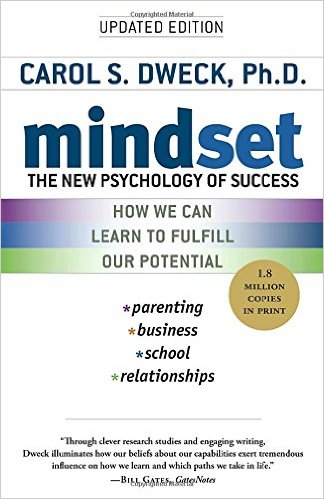
29 Essential Quotes from Mindset: The New Psychology of Success

Mindset is one of those books that has the power to powerfully change all of your most important beliefs and perspectives: the way you view yourself, others, and what is possible. Although the concepts around growth mindset are especially relevant to educators, we are called to be learners and we all have the potential to grow. This book has permanently changed the way I view myself and I believe it might do the same for you. I definitely recommend it.

From the 2016 updated edition, here are (what I believe are) the 29 most significant highlights from Carol Dweck’s Mindset: The New Psychology of Success.

  1. “The view you adopt for yourself profoundly affects the way you live your life.” (p.6)
  2. “This growth mindset is based on the belief that your basic qualities are things you can cultivate through your efforts, your strategies, and help from others. Although people may differ in every which way – in their initial talents and aptitudes, interests, or temperaments – everyone can change and grow through application and experience.” (p.7)
  3. “You can see how the belief that cherished qualities can be developed creates a passion for learning. Why waste time proving over and over how great you are, when you could be getting better? Why hide deficiencies instead of overcoming them? Why look for friends or partners who will just shore up your self-esteem instead of ones who will also challenge you to grow? And why seek out the tried and true, instead of experiences that will stretch you? The passion for stretching yourself and sticking to it, even (or especially) when it’s not going well, is the hallmark of the growth mindset. This is the mindset that allows people to thrive during some of the most challenging times in their lives.” (p.7)
  4. “In one world, effort is a bad thing. It, like failure, means you’re not smart or talented. If you were, you wouldn’t need effort. In the other world, effort is what makes you smart or talented.” (p.16)
  5. “People in a growth mindset don’t just seek challenge, they thrive on it. The bigger the challenge, the more they stretch.” (p.21)
  6. “When do people with the fixed mindset thrive? When things are safely within their grasp. If things get too challenging – when they’re not feeling smart or talented – they lose interest.” (p.22)
  7. “In the growth mindset, it’s almost inconceivable to want something badly, to think you have a chance to achieve it, and then do nothing about it.” (p.44)
  8. “You can look back and say, “I could have been …,” polishing your unused endowments like trophies. Or you can look back and say, “I gave my all for the things I valued.” Think about what you want to look back and say. Then choose your mindset.
  9. “… even when you think you’re not good at something, you can still plunge into it wholeheartedly and stick to it. Actually, sometimes you plunge into something because you’re not good at it. This is a wonderful feature of the growth mindset. You don’t have to think you’re already great at something to want to do it and to enjoy doing it.” (p.53)
  10. “People are all born with a love of learning, but the fixed mindset can undo it. Think of a time when you were enjoying something – doing a crossword puzzle, playing a sport, learning a new dance. Then it became hard and you wanted out. Maybe you suddenly felt tired, dizzy, bored, or hungry. Next time this happens, don’t fool yourself. It’s the fixed mindset. Put yourself in a growth mindset. Picture your brain forming new connections as you meet the challenge and learn. Keep on going.” (p.53)
  11. “The students with growth mindset completely took charge of their learning and motivation. Instead of plunging into unthinking memorization of the course material, they said: “I looked for themes and underlying principles across lectures,” and “I went over mistakes until I was certain I understood them.” They were studying to learn, not just to ace the test. And, actually, this was why they got higher grades – not because they were smarter or had a better background in science.” (p.61)
  12. “Just because some people can do something with little or no training, it doesn’t mean that others can’t do it (and sometimes do it even better) with training. This is so important, because many, many people with the fixed mindset think that someone’s early performance tells you all you need to know about their talent and their future.” (p.70)
  13. “Do you label your kids? This one is the artist and that one is the scientist. Next time, remember that you’re not helping them – even though you may be praising them … Find a growth-mindset way to compliment them.” (p.81)
  14. “Those with the growth mindset found setbacks motivating. They’re informative. They’re a wake-up call.” (p.99)
  15. “If the wrong kinds of praise lead kids down the path of entitlement, dependence, and fragility, maybe the right kinds of praise can lead them down the path of hard work and greater hardiness.” (p.137)
  16. “Parents think they can hand children permanent confidence – like a gift – by praising their brains and talent. It doesn’t work, and in fact has the opposite effect. It makes children doubt themselves as soon as anything is hard or anything goes wrong. If parents want to give their children a gift, the best thing they can do is to teach their children to love challenges, be intrigued by mistakes, enjoy effort, seek new strategies, and keep on learning. That way, their children don’t have to be slaves of praise. They will have a lifelong way to build and repair their own confidence.” (p.179-180)
  17. “One more thing about praise. When we say to children, “Wow, you did that so quickly!” or “Look, you didn’t make any mistakes!” what messages are we sending? We are telling them that what we prize are speed and perfection. Speed and perfection are the enemy of difficult learning: “If you think I’m smart when I’m fast and perfect, I’d better not take on anything challenging.” (p.182)
  18. “Many educators think that lowering their standards will give students success experiences, boost their self-esteem, and raise their achievement. It comes from the same philosophy as the overpraising of students’ intelligence. Well, it doesn’t work. Lowering standards just leads to poorly educated students who feel entitled to easy work and lavish praise.” (p.196)
  19. “The great teachers believe in the growth of the intellect and talent, and they are fascinated with the process of learning.” (p.197)
  20. “Great teachers set high standards for all their students, not just the ones who are already achieving.” (p.200)
  21. “When students don’t know how to do something and others do, the gap seems unbridgeable. Some educators try to reassure their students that they’re fine just as they are. Growth-minded teachers tell students the truth and then give them the tools to close the gap.” (p.203)
  22. “So, are great teachers born or made? … It starts with the growth mindset – about yourself and about children. Not just lip service to the idea that all children can learn, but a deep desire to reach in and ignite the mind of every child.” (p.205)
  23. “A growth mindset is about believing people can develop their abilities. It’s that simple.” (p.215)
  24. “Let’s be totally clear here. We as educators must take seriously our responsibility to create growth-mindset-friendly environments – where kids feel safe from judgment, where they understand that we believe in their potential to grow, and where they know that we are totally dedicated to collaborating with them on their learning. We are in the business of helping kids thrive, not finding reasons why they can’t.” (p.217)
  25. “It’s the parents who respond to their children’s setbacks with interest and treat them as opportunities for learning who are transmitting a growth mindset to their children. These parents think setbacks are good things that should be embraced, and that setbacks should be used as a platform for learning.” (p.219)
  26. “People with a growth mindset are also constantly monitoring what’s going on, but their internal monologue is not about judging themselves and others in this way. Certainly they’re sensitive to positive and negative information, but they’re attuned to its implications for learning and constructive action: What can I learn from this? How can I improve? How can I help my partner do this better?” (p.225)
  27. “Maggie’s internal monologue used to say: Don’t do it. Don’t take a writing class. Don’t share your writing with others. It’s not worth the risk. Your dream could be destroyed. Protect it.” (p.227)
  28. “Instead of being held captive by some intimidating fantasy about the Great Writer, the Great Athlete, or the Great Genius, the growth mindset gave them the courage to embrace their own goals and dreams. And more important, it gave them a way to work toward making them real.” (p.228)
  29. “Mindset change is not about picking up a few pointers here and there. It’s about seeing things in a new way. When people – couples, coaches and athletes, managers and workers, parents and children, teachers and students – change to a growth mindset, they change from a judge-and-be-judged framework to a learn-and-help-learn framework. Their commitment is to growth, and growth takes plenty of time, effort, and mutual support to achieve and maintain.” (p.254)

51FexyX8WQL._SX322_BO1,204,203,200_