Categories
Apple Investing Stock Markets Stocks Tesla

5 Stocks That Are Performing Well for Me in 2023

We’re half-way through the year, and 2022 is becoming a distant memory.

I am NOT a pro investor.

My wife and I both contribute to healthy pension plans through our employers, but if you believe Dave Ramsey, that’s not enough to assure anyone of a comfortable retirement. Do more, he encourages.

Two years ago, we agreed to start making modest monthly 3-figure contributions to our TFSAs (Roth IRAs for my American friends) through QTRade.com (which charges a $10 flat rate per trade), and we’ve kept it up faithfully ever since.

We didn’t know much about stock trading. But we were excited to learn.

Picking single stocks (as opposed to mutual funds, ETFs, indexes, or other collections) is not for the faint of heart. Prices can rise and fall precipitously based on changing economic conditions outside of anyone’s control.

And I’ll be real: the steady decline across the markets in 2022 was not fun. But instead of worrying endlessly, we simply decided to sit tight and ignore the daily news. We refused to sell, and we’ve been rewarded by the comeback of 2023 that you’ll see below.

No, you don’t need to do a ton of market analysis before buying stocks. One rule has stood me well: invest in companies that you know, like, trust, and use every day. By and large, you’ll see that theme appear often in the stocks below.

We’re half-way through the year, which means it’s a good time to give my portfolio a close review. Not every stock has been a winner, but my overall portfolio is doing well thanks to these companies.

Without further ado, here are my biggest winners of the year so far (ranked by percentage gains to date in 2023).

Five stocks that are carrying my portfolio

TSLA — Tesla

  • $211.94 USD/share: my average purchase price (prior to 2023)
  • $108.10 USD/share: market price on January 3, 2023
  • $265.28 USD/share: current market price
  • Gain/loss of the stock to date in 2023: +145.40%
  • Gain/loss on my personal investment: +25.2%
  • Dividend yield: none

Can you say WOW? Tesla’s rise this year is simply stunning.

Remember: you’ll do well to buy the brands that you know, like, and trust. My wife and I are three years into our Model 3, and this car is still a treat to drive every day. We believe in this company and its future.

When you zoom out to the five-year view on this stock, you’ll see that Tesla’s last three years have been a wild ride of ups and downs. At its peak in November 2021, Tesla hit a (split-adjusted) price of $407.36/share. From there, 2022 saw a steady decline in the share value as Tesla missed a number of expectations and Elon Musk appeared distracted by the acquisition of Twitter.

But 2023 has been all comeback. For mega-investors like Cathie Wood, who bought large shares of Tesla stock when it dipped close to $100/share in January, it’s been a good year.

Why didn’t we buy more shares ourselves? Well, it’s the uncertainty of the markets, I guess. Nothing is a sure thing.

But going back to my rule of investing in the big companies that we know, like, trust, and use every day, we won’t make that same mistake twice.

PMET — Patriot Battery Metals, Inc.

  • $4.08 CAD/share: my average purchase price
  • $5.69 CAD/share: market price on January 3, 2023
  • $13.32 CAD/share: current market price
  • Gain/loss of the stock to date in 2023: +134.09%
  • Gain/loss on my personal investment: +226.5%
  • Dividend yield: 0.50%

It’s been a fun ride with Patriot Battery Metals, a small Canadian mining company with a focus on lithium (an important mineral in the car battery industry). Sadly, when a relative advised me to get in on Patriot when the stock was under $0.30/share, I was reluctant to move. Once the stock grew from there to $4.00/share, I swallowed my chagrin at the profits missed and finally purchased. It continues to grow.

As you can see, this stock has not produced a steady climb, so my wife (who also owns shares) and I don’t watch prices here too closely. That said, we’d love to see Patriot return to its high of $17.53/share set in June of 2023.

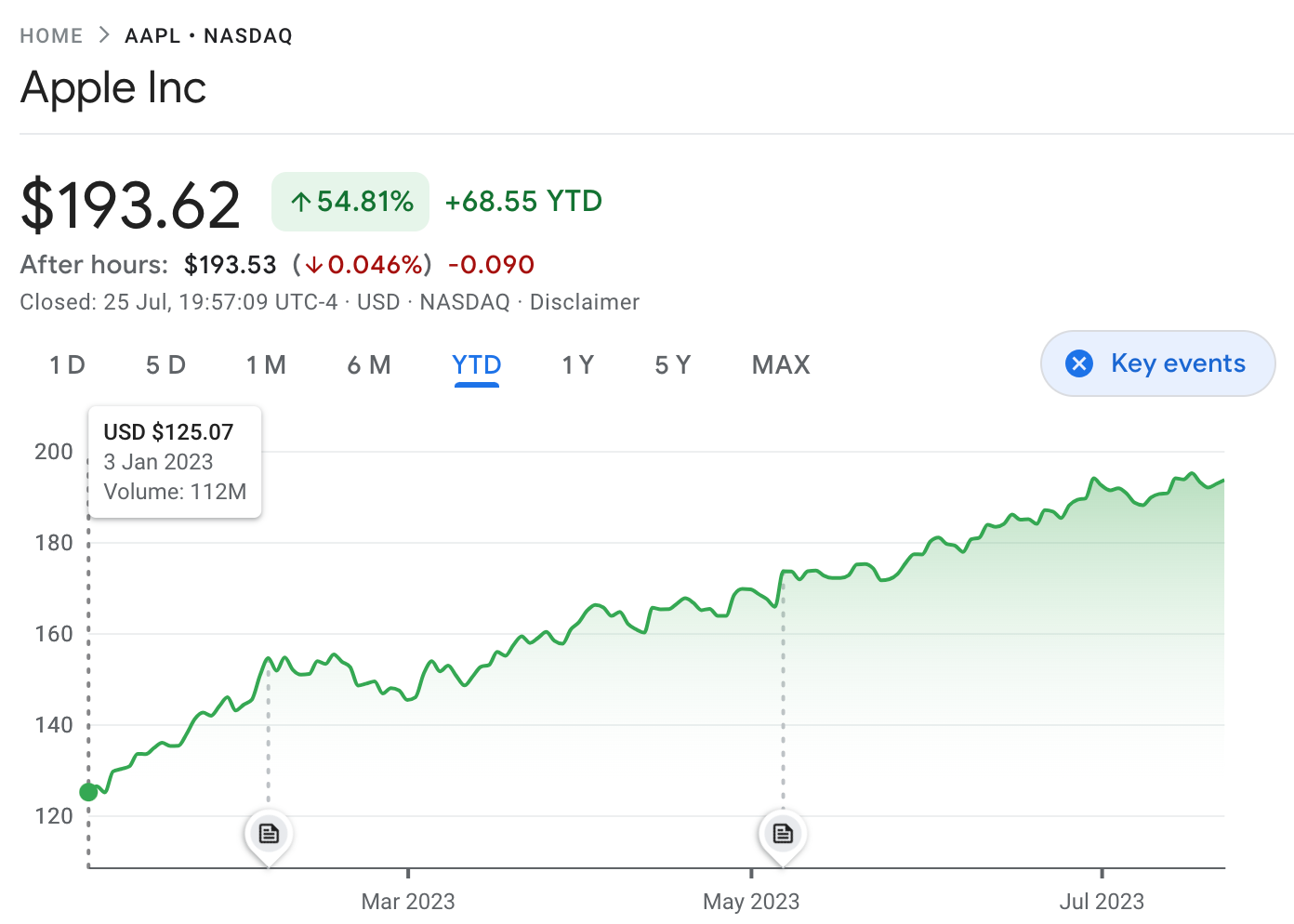
AAPL — Apple

  • $130.05 USD/share: my average purchase price (prior to 2023)
  • $125.07 USD/share: market price on January 3, 2023
  • $193.62 USD/share: current market price
  • Gain/loss of the stock to date in 2023: +54.81%
  • Gain/loss on my personal investment: +48.9%
  • Dividend yield: 0.50%

Remember when the doubters predicted that Apple would tank after Steve Jobs left the company? Fun times.

Apple is the largest company in the world by market cap and continues to lead the way in terms of quality and reliability. I’m currently writing on a Macbook Pro and sitting with an iPhone 13 Pro, an Apple Watch, and AirPods. I’m all in on Apple.

How long will Apple’s ascent continue before it hits a significant trough? For the time being, Apple investors are watching closely to see if the stock can break $200/share.

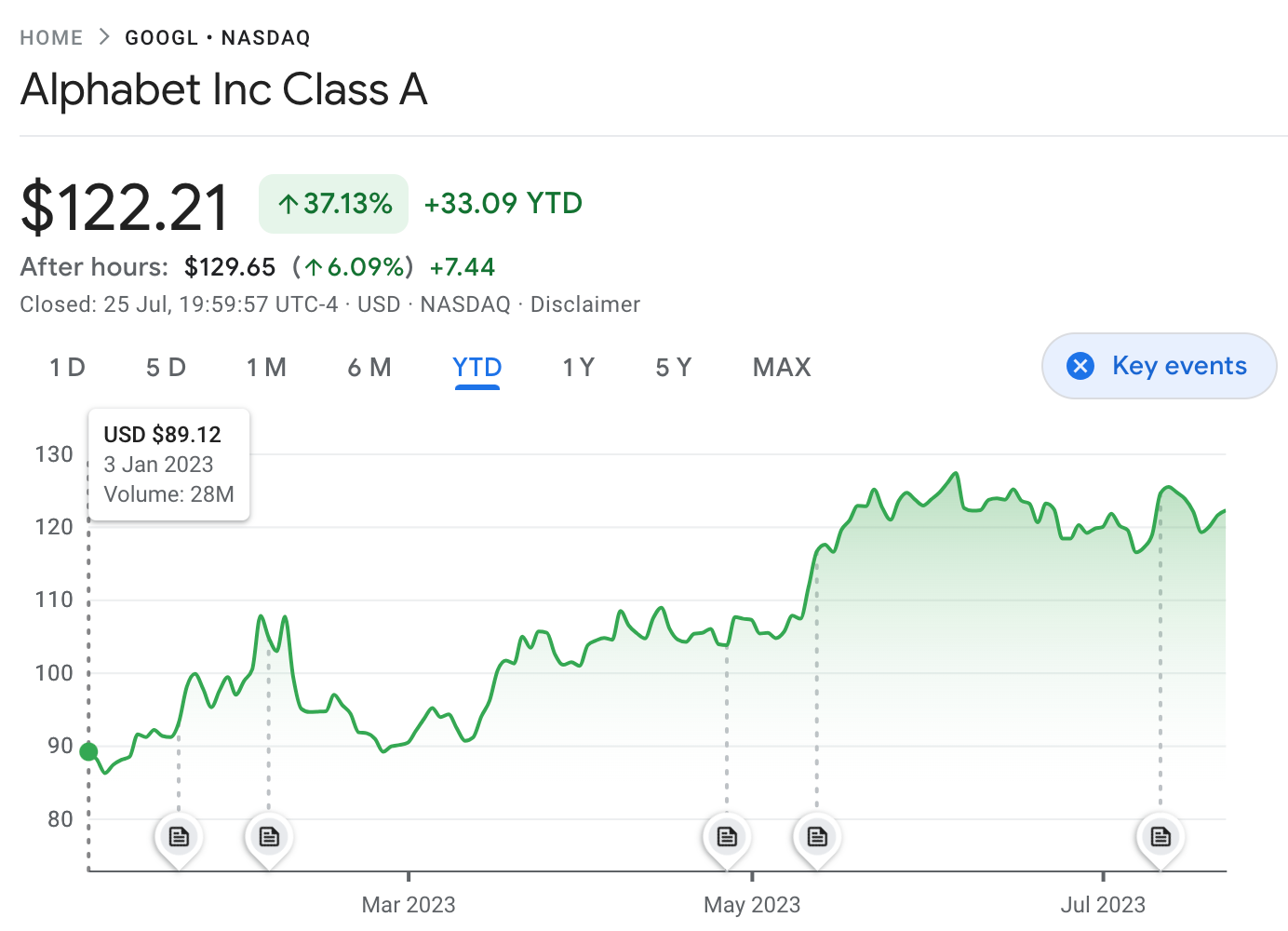
GOOGL — Alphabet (Google)

  • $108.40 USD/share: my average purchase price (prior to 2023)
  • $89.12 USD/share: market price on January 3, 2023
  • $122.21 USD/share: current market price
  • Gain/loss of the stock to date in 2023: +37.13%
  • Gain/loss on my personal investment: +12.7%
  • Dividend yield: none

Google is yet another brand that I know, love, and use every day. I am writing this blog post in Google Docs, for example. I spend time in the Google Workspace every day without fail in both my personal and professional lives.

As the fourth largest company in the world, this monster’s continued growth seems assured. With a host of services that the world relies on every day, it’s not going anywhere.

Even with a gain of 37% on the year, I consider this a safe investment for the indefinite future. That said, would I like to see something new, bold, and innovative from this company? Yes.

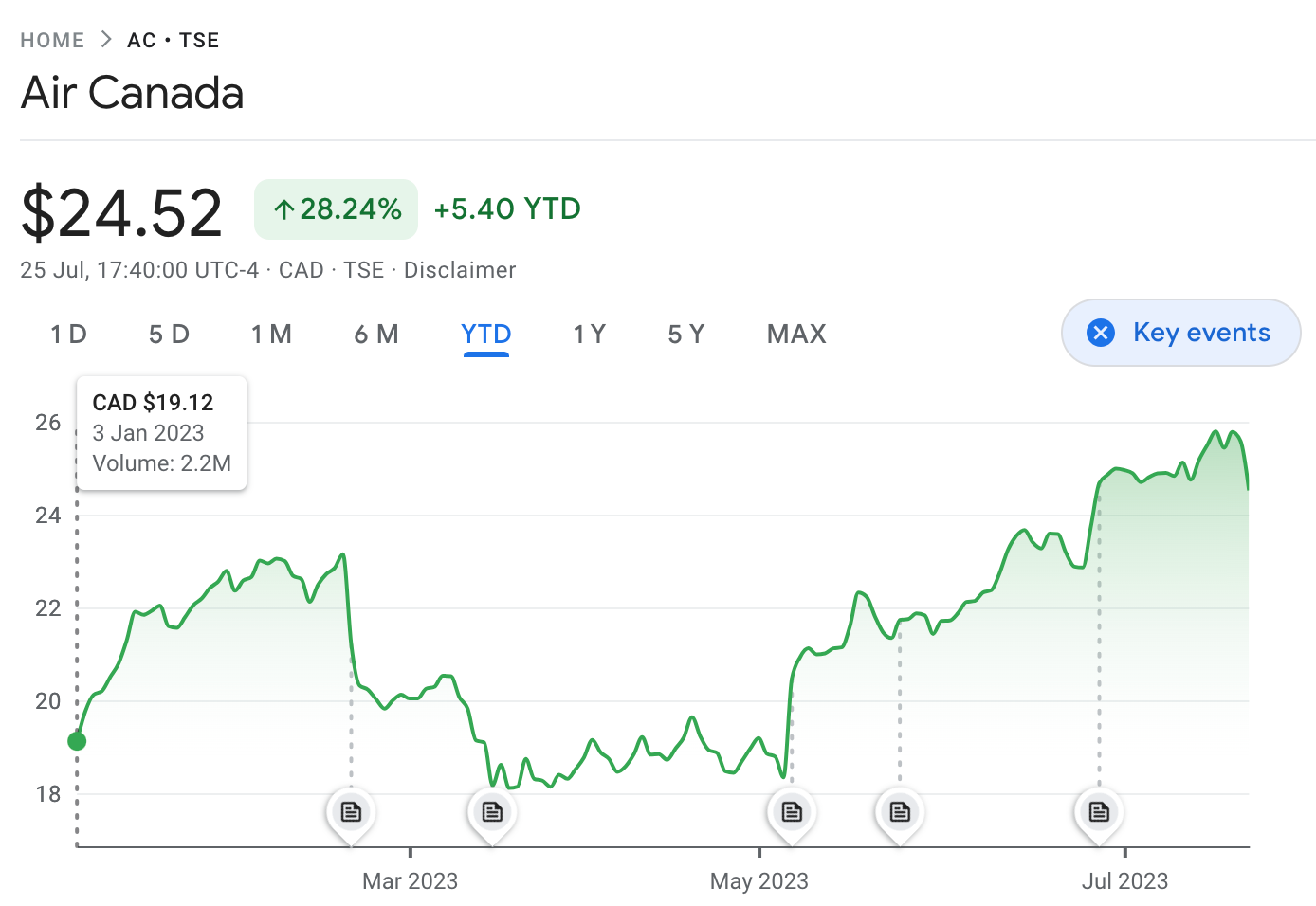
AC — Air Canada

  • $23.36 CAD/share: my average purchase price (prior to 2023)
  • $19.12 CAD/share: market price on January 3, 2023
  • $24.51 CAD/share: current market price
  • Gain/loss of the stock to date in 2023: +28.24%
  • Gain/loss on my personal investment: +4.9%
  • Dividend yield: none

I first bought Air Canada shares at the heart of COVID times, thinking a major bounce-back after the pandemic was all but inevitable once the pandemic was over (shares sat at $51.08 in January 2020, so I figured they would make their way back to those heights quickly).

That comeback has been slow, but the word from the airlines is that customers are BACK. Air Canada recently boosted its earnings forecast for 2023, and I expect this climb to continue.

What’s winning for you right now?

Western markets have been defying the doomsday recession predictions so far this year. Will this trend continue for the rest of the year? And which companies have performed well for you? Let me know.

Categories
Career Finances Goal Setting Investing Productivity

Financial Advice for My 21-Year-Old Sons

Boys, you’ve just entered your teens … but 21 is just around the corner. Learn from my mistakes to set yourself on an early path to financial freedom.

Photo by rawpixel on Unsplash

DON’T use credit cards to finance vacations “while I’m still young.”

Relax. The travel window isn’t about to close for you any time soon. Sure, my cross-continent trips with friends were fun at the time, but the multi-thousand dollar credit card debt to follow was miserable. No one sets out in life to pay Visa and MasterCard thousands of dollars in interest, but that’s exactly what you’re choosing to do when you rack up 5-figure credit card debt on a small salary. Renowned financial consultant Dave Ramsey calls this kind of behavior stupid tax.

DO save a little money each month.

Whether it’s $250 or $25/month, the decision to save consistently over time will literally pay dividends down the road. A quote attributed to Albert Einstein says “Compound interest is the eighth wonder of the world. He who understands it, earns it. He who doesn’t, pays it.” Choose to be an interest earner, not a slave. Tax-free interest savings plans like Roth IRAs (USA) or TFSAs (Canada) make the effect of interest earnings even more amazing.

The 1998 Chevrolet Cavalier Z24

DON’T borrow money to buy a vehicle.

Little did I know that when I borrowed $12,500 to buy a 3-year-old car, it would ultimately cost me thousands more in repairs and take me several years to pay off completely. Always remember: buying a car is the single largest purchase of a depreciating asset that most people will ever make. Instead of thinking about features, think about limiting the financial damage by spending within your means for a vehicle that’s reliable.

DO purchase real estate as soon as possible.

Just as car debt is financially damaging, the decision to buy your first piece of real estate will prove to be one of the most important financial moves of your life. Among a host of other benefits, mortgage payments are a form of forced savings that will only give you better options and opportunities as the years go by. Don’t try to tell yourself that you’ll rent on the cheap and put a ton of money into savings and investments. You won’t.

Quick story on this point. As I mentioned, I borrowed a large sum of money at 21 years of age to buy a used vehicle. Around the same time and at the same age, my friend Brent bought a home for $29,000. Yes, it was a small home in a bad area and a depressed market. But predictably, his house appreciated well in the few years that followed. I believe he sold his home for about $90,000 about three years later and rolled that equity into a larger $150,000 home in a nicer area of town.

So, consider our two trajectories during this approximate five year window. I probably paid close to $20,000 in car payments, interest, and repairs, and was left with little to show for it. In contrast, Brent likely put about $5,000 down on his home and paid up to $2,500/year in mortgage payments, for a total of $17,500 in on his house before selling.

Although my numbers can’t be precise, our decisions created these divergent results:

  • Me: loss of $20,000 + “gain” of an unreliable vehicle
  • Brent: gain of $70,000 + growing equity and appreciation in a $150,000 property

If the numbers aren’t making it clear, just go with this: Don’t borrow money to buy things with engines. Buy real estate instead.

Photo by rawpixel on Unsplash

DON’T automatically accept the first job offer that comes your way.

Filled with idealism and sentiment for my would-be employer, I accepted a teaching position almost immediately after graduating from university with a bachelor’s degree. Yes, I built meaningful friendships and gained valuable experience during the six years that followed, but the starting salary of $24,000 (before taxes and deductions) with limited opportunity for advancement was a bad return on a 4-year university program. After making poor money decisions in other areas, earning less than $450/week was simply not enough income to create any kind of financial momentum.

DO be selective and explore all of your income options.

In some respects, you may never again have as much vocational freedom as you will in your twenties, something perhaps more true in the gig economy of today than it’s ever been true in human history. Find work that is spiritually satisfying, intellectually challenging, and complements your set of abilities and interests. And yes, find work that compensates you appropriately and offers avenues for advancement. Whether you find this in corporate America or as an entrepreneur, seize the opportunity to avoid the prospect of a financial flatline.

Photo by Krists Luhaers on Unsplash

DON’T consume much entertainment.

Going to movies, watching professional sports, and playing video games were all fun distractions, but they add nothing of value to your life and leave no lasting legacy. I’ll never get back the hours I spent wandering around Blockbuster Video stores looking for movies to rent — never mind the hours I spent actually watching the movies! Instead, focus on leisure activities that grow your skill set, leave lasting impact, and develop your leadership.

DO create content consistently.

Consistent content creation over time has a way of building permanent momentum, income, and opportunities. Every successful artist and creator from the blogosphere, Twitter, Medium, Youtube, or Instagram once began with zero followers and subscribers. Even the simple decision to write an article like this one once a week from the age of 21 would have set me on a completely different trajectory, and it’s certain that my writing style would have developed far more by following this simple habit.

Consistent content creation will make you more reflective, develop your mind, build your creativity, broaden your horizons, expand your networks, and create opportunities that you never thought possible. Be a constant creator. Whether it’s through writing, music, photography, or how-to videos on YouTube, create and contribute things of beauty and utility as a way of life.

Photo by frank mckenna on Unsplash

In Summary

Your early twenties. Those years are such a fantastic opportunity to work hard and save cash for things like cars, weddings, and homes — not necessities, by any means, but building blocks for a functioning life that will become more significant in the years and decades ahead. Treated with care, these years can set you on a course that will have you thanking yourself for decades.

So boys, learn from my errors. Observe the stupid taxes I paid. And make smarter decisions than I did. You’ll thank yourself for the rest of your life!

Categories
Business Entrepreneurship Investing Lifestyle Real Estate

7 Reasons Why Real Estate is Still the Best Place to Invest

Even as borrowing rates rise, real estate wins. Here’s why.

Photo credit: Scott Webb

With a world of options available to today’s investor, it can be hard to know what will produce the greatest bang for your buck. What follows are the reasons why, in my opinion, real estate is still the investment champ.

1. Real estate offers a significant human service.

Shelter is one of humanity’s most basic needs. As a landlord, it’s an honor to provide a safe, secure, and dry space for others to live and love and work and build relationships. Showing genuine care for tenants, taking pride in a property, and maintaining it with dignity can create great satisfaction.

2. The demand for real estate is permanent.

People will always need a place to live or work, meaning your investment property will always have interested renters or buyers. Housing is not a fad, land will always have value, and the demand for real estate will not go away.

3. Real estate offers a measure of control.

As an investor, you have the power to set rental rates, screen renters, determine upgrades, and even choose the paint color. You can physically see and touch your investment, inspecting it as you wish. Other investment classes, such as the stock market or venture capital, offer limited control and transparency — sometimes almost none at all.

4. Real estate investments create passive streams of income.

To acquire a desirable property is to acquire a (generally) permanent and ongoing flow of passive income. Even if you don’t net a dime of positive cash flow in the short term — meaning all you’re doing is breaking even on expenses each month — the payments made against the mortgage principal mean you’re steadily building equity. The more you replicate this activity, the more equity gained, even if your chequing account looks as tight as ever.

5. Market appreciation is reliable over the long term.

Sometimes the market is hot, like three years ago when our Pacific northwest home appreciated over 30% in one year. Sometimes it’s cold, like this year and for the foreseeable future as rising interest rates lower the purchasing power of buyers, and the market predictably sags.

But regardless of the ebbs and flows, North American real estate shows a steady appreciation over time. Choose any 10-year window in any market and you’ll find measurable appreciation. In real estate hot spots where mountains, ocean, international boundaries and other factors combine to limit the growth of new development, market appreciation is even more of a guarantee. And when the market explodes forward as it did in the Lower Mainland of BC in 2015, the equity gains can make anything in the stock market pale by comparison.

6. Investment property improvements are tax-deductible.

Let’s say you invest $20,000 to upgrade your kitchen in your own home. It looks great, and you love the upgrade, and it may even add market value to your home — but there’s no tax advantage to be realized there. On the other hand, when you make similar improvements on a rental property, those investments count against any taxes that you would normally pay on your rental income.

Governments set these policies to encourage landlords to maintain their properties and provide better quality housing for their renters — a great example of humane public policy. As a landlord, you gain by adding value to your investment property while rightly avoiding taxes at the same time. Win-win.

7. Real estate investments produce incredible leveraging power that other asset classes can’t match.

This point may just be the best of them all, and it’s one that your stock market friends forget about. Think of it this way.

Let’s say your pension fund is worth $500,000. Can you visit your local lender and ask her to use your pension funds as collateral for a $100,000 loan? Absolutely not. But trade that $500,000 bundle of investments for a property with equity of $500,000 in it, and the bank would be only too happy to issue the $100,000 loan (using the property as collateral).

As your real estate investments appreciate and gain equity over time, banks and other lenders will allow you to borrow against those properties (usually up to 70–80% of the equity in the property, depending on the lender). And to make this dynamic even sweeter, there’s an accumulating effect.

Imagine this scenario. Let’s say you invest in Property A. After a few years of payments on the mortgage principal + market appreciation there is significant equity growth in that property. You could then borrow against that equity to invest in Property B. The cycle repeats itself, although slightly faster this time, because now there is equity growth in not one but two properties. A few years later, you visit the bank again to borrow against A and B, and you purchase property C. And so on, and so on.

Other investment classes don’t allow you to borrow against them in this same way. And so that cumulative or multiplying effect is lost.

Some Admissions

There are a few points I’ve oversimplified here for the sake of argument. Yes, it’s possible to overpay for dilapidated properties. Yes, it’s possible to purchase properties in remote areas with dubious potential for appreciation. Yes, it’s possible to purchase properties in overpriced markets that can’t hope to generate sufficient rental incomes to cash flow positively. Other risks, including bad tenants who may inflict significant damage on properties, certainly exist as well.

In Summary

All of these disclaimers aside, I’m supremely confident in the power of this asset class to win the day. Done right, real estate offers permanent value, good control and visibility, steady income, reliable appreciation, tax advantages, and a multiplying effect that other assets can’t match. I’ve seen what it can do in the past, and I intend to see what else it can do in the future.

Have you got a strong yay or nay response to my thesis that real estate is still the best investment class? Throw your hat in this discussion by commenting below, and thanks for reading.